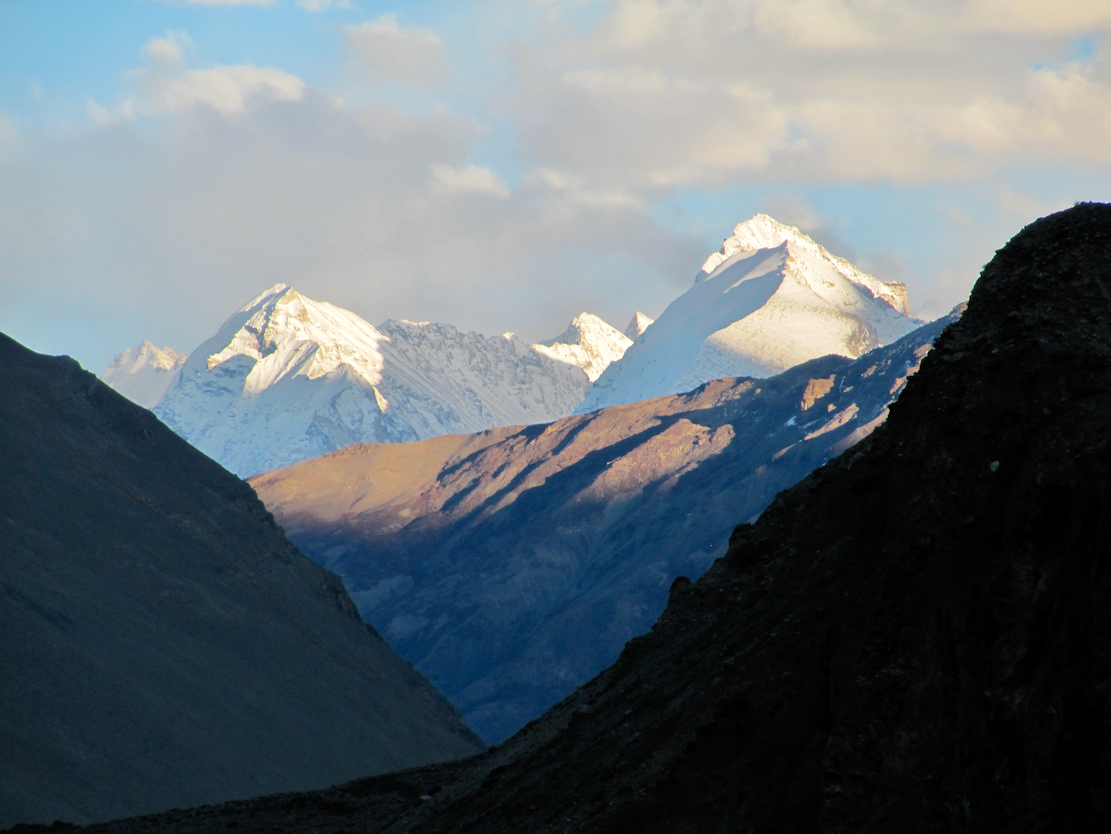


After riding the Karakoram Highway from Kashgar and on to Chitral in 2008, Steve headed for Ladakh in late September 2009, aiming to ride over some of the world’s highest road passes.
Written by Steve Lord and originally published in the Adventure Cycle Touring Handbook 2010 (right).
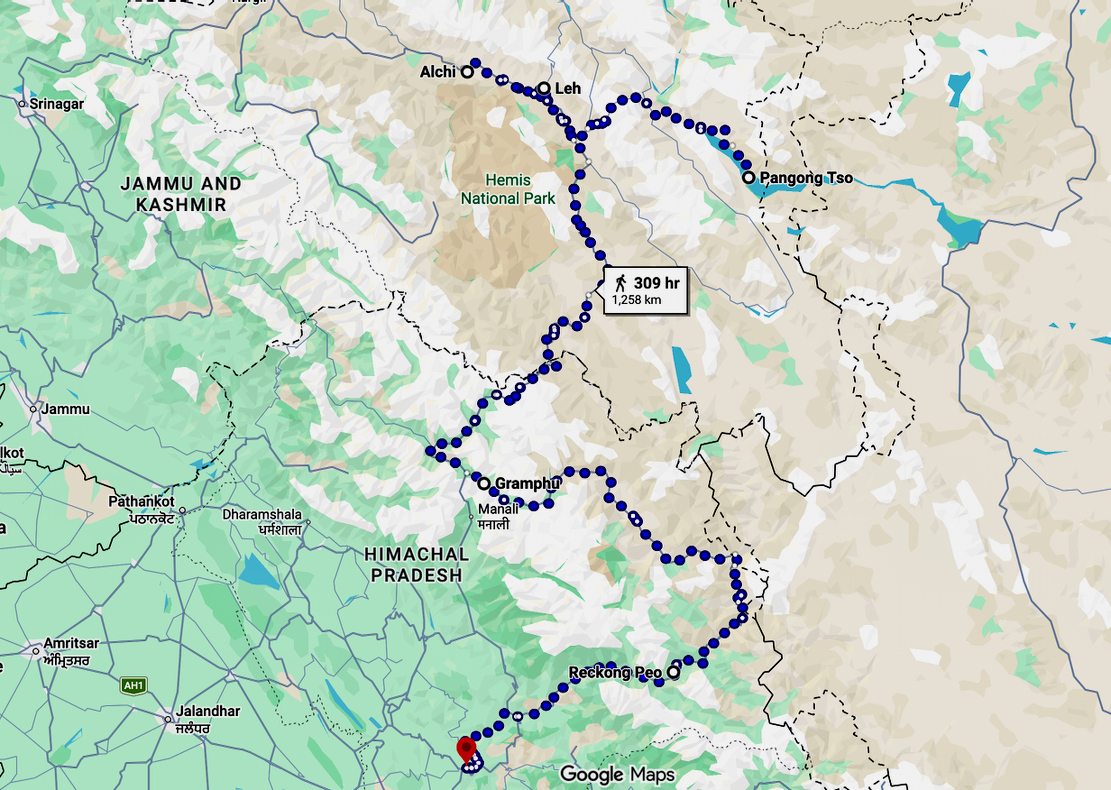
The video above covers the first half of our ride 400km from Leh to Gramphu. For Spiti which followed, see this
But I was going to do the Camino de Santiago!’ I said when Chris reminded me we’d talked about a trip to Ladakh. ‘You can do that when you’re old!’, he countered. We’d both enjoyed riding the Karakoram Highway the previous year and had talked about Ladakh for this year. High altitudes are hard going at any age; it takes a lot of time and effort just to get there and acclimatise before the riding even begins, and this was an opportunity to do one more high altitude ride in good company: we might not get a chance again.


We flew into Leh and checked into the Oriental, the best backpacker hangout in town, and spent a week getting to know Leh and visiting nearby gompas (monasteries). Although the passes would soon be snowed in, we thought that an extra day or two’s acclimatisation would pay off and, after eight days in Leh, headed off towards Taglang La
(5300m), one of the highest road passes in the world.


Tackling the Taglang La
We spent our first night near Upshi at the foot of the climb, no higher than Leh at around 3500m, under a parachute tent at the pashmina goat farm where we were made welcome. Next day a fairly effortless 700m climb led to the village of Rumtse, where we planned to spend a further day acclimatising. On our rest day we climbed a few kilometres up the pass and cached some water for the next day, as Tanglang La is a pretty dry pass on both sides.


Although the gradient is gentle, it’s a long haul and the asphalt runs out at around 4900m but still 16km from the summit. We stopped for lunch when Chris, who’d always doubted his ability to ride at such altitude, admitted he’d suddenly ran out of steam and didn’t want to push on. We talked over our options: camping there and continuing the next day, or me riding on while Chris hitched a ride to the pass and waited. Camping without water would be a problem and it’s never a great idea to ride solo at such heights, especially in the shorter days and colder nights of autumn. There was no certainty that I wouldn’t run out of steam myself just round the corner.
I’ve twice run out of energy before at altitude while riding in Tibet. It’s entirely predictable, like running out of fuel in a car, but the exact moment it will happen is impossible to know. If you’re climbing a pass, you’ll be struggling just to push the bike or more likely sitting down in a daze, wondering what to do next.


The very next Tata truck stopped for us and we hopped in the back with our bikes. We both knew we’d done the right thing when we saw how far it actually was to the pass. ‘One of the great things about a bike is that you can always throw it in the back of a truck’ said Chris, as we put on all our clothing for the freewheel down the far side. We detoured to Tso Kar lake, arriving at dusk with just enough energy to put up the tents. At around 4500m it was a freezing night and dawn brought with it a light sprinkling of snow.


Back on the main road, a fierce headwind rose up over the dusty Morei Plains, taking the wind chill to well below zero. An Indian car rally was heading north which meant even more dust, but also lots of smiles and honks from balaclava-clad participants who were even less used to the cold than we were.
For 200km the central part of the Leh-Manali road lies above 4500m (14,800 feet) and there are no villages en route, just temporary encampments of parachute tents offering shelter and the Himalayan standards of pressure-cooked rice with dhal and chapatti omelettes. Any fixed toilet facility is a bonus, but once the water freezes, people prefer the al fresco option that comes with river views.


More 5000m passes
We’d been warned about the dawn reveille of revving trucks and so had brought ear plugs, but the belching smoke from the ageing Tatas was a real shocker. After yesterday’s morale-sapping haul against the wind, at Pang we clutched our coffees in the warming sun, contemplating what this day would bring. Our goal was to get over the double pass of Lachulung La and Nakeela La, another 5000m+ col. We set off up a sandstone gorge which opened out into a broad upland valley. Chris was riding well and as we rounded a corner beyond the gorge he proclaimed we’d burst through the 5000-metre barrier and could see the summit prayer flags just ahead. I carried on to the pass, but a few hundred metres from the top I looked down to see Chris slumped against a rock. One-thirty, that’s getting late I thought; we need some lunch in us or we could be in trouble again. I soon got some noodles on the boil; he’ll be pleased to see lunch waiting for him, I thought
as time slipped by. Twenty minutes later a car stopped and asked if I was ‘Mr. Steve’. Chris had been laid low by stomach troubles and I was to go back.
All I could think of was keeping his share of the cooked noodles, remote though the prospect was of him wanting them, and packed the pot carefully in my panniers before riding back down. Struck by sudden hunger, earlier he’d devoured a snack of his own, but it had shot through rather than revived him and now, noodles were the last thing on his mind.
Again, the first truck stopped for us, Chris got in the cab and I jumped in the back with the bikes. As I tried to lash them down the truck lurched off and before I knew it baggage and bikes were bouncing off the walls as I thought only of keeping the noodle pannier upright. I yelled at the driver to slow down, fearful that if I were knocked out I’d be found in a mess of blood, dust and spokes tangled with warm noodles.
Chris told me afterwards they couldn’t hear a thing and anyway the driver and his mate were busy sharing a spliff, immune to the carnage in the load bed worthy of a CIA torture manual. I managed to grab Chris’s holdall and sat on that, rodeo style, with one hand on the pannier with the pot-noodles and the other free to balance. The truck hurtled from pothole to rut and as my noodle preserving resolve waned, it pulled over at Nakeela La. This, I thought, was how the Fates punished me for the sin of hitching.


The truck left me shaken by the road while Chris, indifferent to my Herculean noodle-saving efforts and himself wafting in and out of a high altitude and diarrhoea-induced hallucination, waited for me to get up for the count. Slowly I gathered my scattered baggage together and picked up the plot: a splendid afternoon sun cast rich colours over the valley below and ahead of us unrolled a hard-earned 800m descent on a good paved road: what’s to be unhappy about? We cruised down, dawdling on the Gata Loops, a notorious/delirious (depending on your direction) stack of switchbacks, to take photos and suck in the views. Halfway down we passed a jeep taxi that had tumbled down the hillside a few hours earlier.
Sarchu and the Baralacha La
Sarchu is as charmless as any tent village but you have to look beyond the plastic- and post-digestive detritus at the incredible setting – and the fact that the ‘English Wine & Beer’ stall was open! We stayed in a very tidy Nepali-run tent and enjoyed an excellent dhal baht, while huddled round a fire, chatting with some truckers about life on the high roads of the Himalaya.

All that remained was one final pass before we turned off for Spiti. Baralacha La was only 25km away but, with a long run down the other side to Keylong, we decided to ride just 20km to the isolated tent camp at Bharatpur at 4750m, leaving only a 170-metre ascent for the morning. Surely we could ride twenty kilometres in a day? In Chris’ case, only just; at one point he recorded a slurred and garbled video message as we struggled through the jumbled moraine onto the wide valley above.


With the highway about to close for winter, at Bharatpur only two parachute tents were still standing and even they were busy packing up. We spent a happy evening with the Nepali family and surprised them by cooking some cous-cous with biltong for dinner and tsampa-porridge in the morning. By that time it was -10°C but to our relief an easy run led to the snowy crest of 4920-metre Baralacha La and a breathtaking view down the 1700m descent. We’d finally managed to pedal up a Himalayan pass, and once wrapped up against the windchill, cruising down was euphoric, snapping photos of one another as we swung through the switchbacks and freewheeling for miles until the first shrubs, trees and even green grass appeared early in the afternoon.

From Darcha the valley became a deep, steep-sided ravine capped by snowy peaks and glaciers. After days of panting and effort, it was a heavenly ride towards the hoped-for fleshpots of Keylong where surely good food and fast internet awaited. We spent a couple of nights there, challenging the young boys left in charge of the kitchen to do their very best for us, but found only power cuts and no phone or internet, so we resorted to servicing the bikes and washing our clothes on the hotel roof.


At Keylong, or 50km on at Gramphu junction to be precise, we had a choice to head south over the notorious Rhotang pass to Manali, back then a sketchy backpacker hang-out. The Rhotang is only 3980m but, as the southernmost pass of the Himalayan chain, it catches the monsoon rains sweeping north from the baking plains and gets frequently blocked by mud or snow, while the passes we’d just crossed to the north were it its rain shadow and remained open. (In 2020 they completed the 9km Atal tunnel.)
Like the year before in Gilgit, we wanted to string out our Himalayan ride, so at Gramphu junction headed west with a lift to the Kunlum La pass for the Spiti valley beyond, before the road curled back west at the Chinese border for the Lahaul valley and Shimla.
Into the Spiti Valley
Once let loose on the snows of Kunzum La, we were thrilled to be back in Tibetan Buddhist lands, dotted with chortens, prayer flags and mani walls.


From Losar, the first village, the road improved dramatically but with winter setting in, we decided to stay in guesthouses: much easier and warmer than camping and a great way to see how local people live. Buddhists sometimes have a small chapel in their home, which means early morning prayers climaxing with drumming and a clash of cymbals fit to wake a hibernating yeti.Leaving iced-up Losar, we took a turn-off signposted to the village of Chicham, a track which, according to a tip in Himalaya by Bike guidebook, should lead on to Kibber when completed.

At 4200m, Chicham claims to be ‘the highest inhabited village in the world with motorable road and voting ballot’ – this last qualification probably means there are several higher villages in neighbouring Tibet, where they have no ballot! We asked some motorbiking monks if we could get to Chicham this way. They said ‘no’, then ‘yes’ then ‘no’, typical of the way you sometimes have to ask three times to get an average answer. They then mentioned a ‘span’ and oddly, picked up my bike to assess its weight. None the wiser but prepared to give it a go, by lunchtime we’d wheezed to a point high above the Spiti valley and rolled down to Chicham, a pretty Tibetan-style village facing nearby Kibber, just a few kilometres away as the crow flies.
See separate Kibber span video and post
Between the two hamlets lay a deep and as-yet unbridged ravine, perhaps 150m deep and around 100m across. We rode down to inspect the steel cradle and cable contraption used to cross the ravine; the so-called ‘span’. ‘This will be fun…’ exclaimed Chris, but I was terrified by the prospect of dangling over the gorge like a Christmas light bulb on Regent Street and was rather hoping we’d have to backtrack. My hopes were based on the fact that one of the two ropes used to pull the cradle to and fro appeared to be broken and swung limply in the breeze. It was hard to know if it had snapped that day or months ago, but until it was repaired there was no way across. By now starving and cold, we cooked up the last of our food but even then it was my turn to feel feeble. I didn’t have another 10km in me, let alone the 60km it would take to get to the nearest food at Kaza. We pushed the bikes back up to Chicham and after asking around, managed to arrange a homestay with the local schoolteacher.

Soon enough we were indoors shipping chai around a yak-dung fire while our new friend Tashi’s wife made bread for dinner. As we chatted Tashi explained the Tibetan Buddhist logic of killing a single yak in wintertime: the merit that comes from feeding four or five families for several months greatly offsets having to take one life. The family had a young Bihari houseboy, and in a few days their own son, nine-year old Tenzing, was off to join a Tibetan Buddhist monastery in southern India – for life. Tashi explained he wouldn’t see his son for a couple of years but that one of his brothers was a monk there and would look after him. I’d just finished another Dickens novel at the time and was amazed once more at how life for children in Victorian Britain had parallels in today’s India. ‘It’s their industrial revolution, 150 years after ours,’ suggested a traveller we met later, but it’s a hard life, no matter how much the children smile.

Over the gorge
Next morning we rode down to the span to find it not only repaired but with a teenage girl patiently swinging in the cradle, waiting for someone to pull her in. Seeing her so relaxed in that helpless position set my mind at rest; I could manage the span. We pulled her in then Chris got in the cradle and slowly hauled himself across the chasm. The bikes and gear followed and finally Chris pulled me over while I diverted myself by recording the experience on video.


From Kibber we dropped back to the Spiti valley and battled a freezing wind to the grungy town of Kaza where we needed to obtain a permit to transit the Tibetan borderlands.We spent our time in a cosy homestay by the creek, eating with the family around a warm stove. They, too, had a young Indian houseboy Pawan, hard at work cleaning and washing, though he joined the family for meals. It seemed as though he’d miss out on an education but compared with the near-destitute road workers we’d seen living in scrawny tents along the highway, Pawan was much better off. That night snow fell in Kaza, a reminder that our cycling days this year were numbered. We left town and followed the now-turquoise Spiti river as it carved through a series of striking gorges towards the Tibetan frontier.


At the former Raj-era hill station of Shimla we bought some sacks and string and disassembled the bikes for the flight home. In Delhi, with our last rupees we hired an auto-rickshaw to get to the airport. I jammed my superbly compacted bike over the engine while Chris’s filled the space between us and the driver, squashing his face up against the windscreen. With our legs poking out of the sides and our heads bent against the roof, the rickshaw puttered off into the mêlée to join Delhi’s unending reenactment of the Ben Hur chariot race, less the spikes, whips and body armour.
An hour or two later we were back in the fluorescent familiarity of Airport World, gnawing on a pair of fat pizzas, slurping lattes and watching Flight EK515 inch up the departure list.

My Himalayan bike
I don’t know what possessed me to return to the mountains with my too small Specialized HR Pro bought in Kashgar, other than fond memories of our great ride along the KKH the previous year, and that fact that it’s dead easy to upgrade any bike and think you’ve made something better.

Back home from Pakistan with just the frame and my tyres, Ortliebs and rack, I fitted a better Rock Shox fork with a long steerer tube to stack up the ‘bars and new wheels with discs alongside more repairable, Avid cable-operated brakes. There was probably a new saddle and longer seatpost too, as well as the drivetrain. It managed the Himalaya fine.

I kept that HR ratbike for way longer than it deserved before I snapped out of it and briefly had a lovely, bronze Specialized Enduro M5 (above) which I decided was just too nickable for London use. The advent of 29-inch wheels finally brought MTBs in line with my height.
Leave a Reply