

Now with two hefty e-MTBs, the rear hanging racks we’ve used on the Micra for decades (below) would only work once the smaller Lapierre was dismantled and in the back. Even then, at nearly 2m long, my XL, 28-kilo Tero hanging on the rack would still be wider than the car unless I took the front wheel off too. Otherwise, knowing the narrow lanes around Dartmoor or mid-Wales, a protruding wheel would eventually snag a branch, a wing mirror or a drystone wall while squeezing by or backing up. Wheels off is a faff we sought to minimise.

The width of my bike is one reason why a platform rack (below) would also not work. These easy to RoRo racks (below left) carry the weight low and securely on the bikes’ wheels, but are usually tow bar mounted (the leverage does not bear thinking about). Again, the width of my X5 would be an issue, let alone the £400-£1400 for a typical 60-kilo rated two e-bike rack, plus the added cost of fitting a tow bar and rear light board electrics to the old Micra’s rusty underparts. And unlike the hanging racks, the Micra’s rear hatch wouldn’t be accessible with bikes on.
You can dodge a tow bar with Thule’s high lift platform rack (below right) which mounts to the hatch door, like a hanging rack. But they’re only rated to 30 kilos, and besides the ghastly aerodynamics, lifting our e-bikes on and off would soon lose its thrill and the X5 width issue remains.


There’s another disincentive for mounting e-bikes on the back of a car: the low pressure zone which supposedly affects flat-backed hatchbacks and vans more than regular sedans and Maseratis (see image below). This slipstreaming effect you can feel on a moto close behind a lorry can potentially suck water into electrical components on long, fast and wet transits unless the motors and switches are tightly wrapped up or bikes covered. More faffing and flapping. I’m not sure if this problem is the result of someone having a paroxysm of over-thinking or is a genuine issue, but it sounds plausible, on top of the other negative issues of transporting bikes on the back of a car.

We’re gonna need a bigger car
Now with 125,000 miles, the 2003 Micra’s acquired an array of anomalies and bodges to keep it running. Incredibly, it waltzed through a recent MoT which I can only put down to it being booked in at the end of a very hot day. For years we’ve run it rear seat out as a council dump runabout and garden tractor, and lately I’ve used it with just a driver’s seat to transport the Tero X5 (below). The Lapierre would squeeze in too, but obviously not a passenger in any sort of comfort or safety.
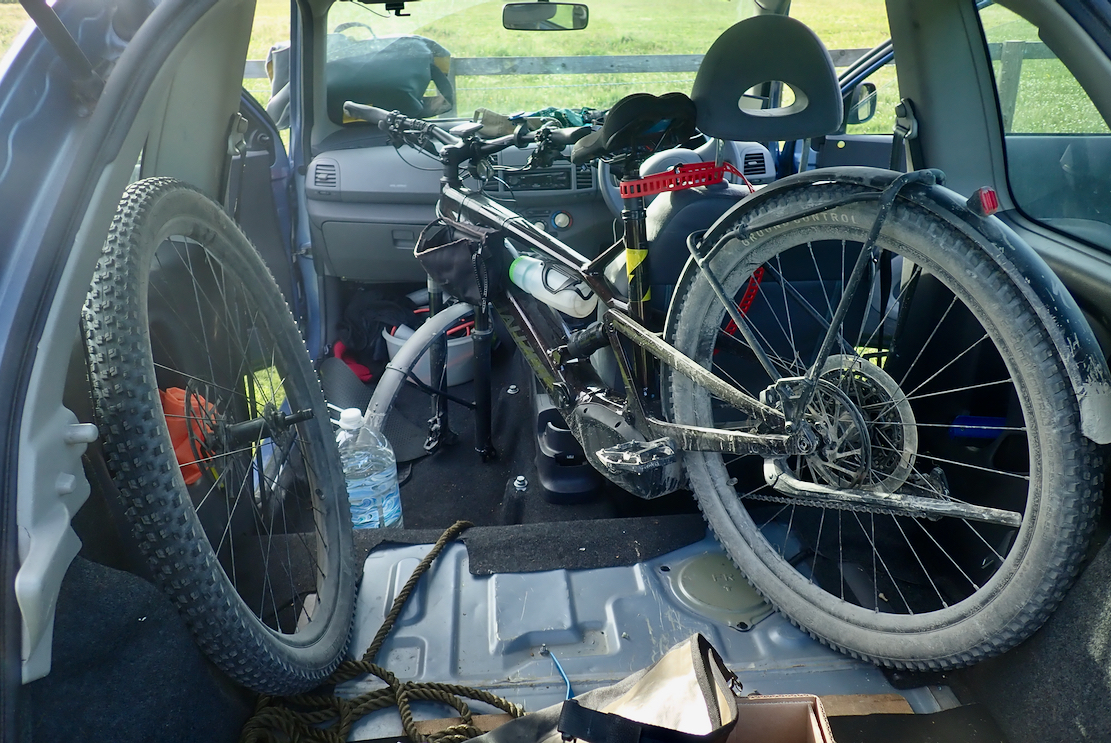
So there ensued days of online burrowing along the used car rabbit hole superhighway in search of a two bike transporter that wasn’t a white van and came with air, satnav, reversing cam, sliding doors and many other mod cons which pore-dated the Nissan. To cut a long story short, that added up to the XL ‘lifestyle’ variant of a 7-seater MPV including:
- Citroen Berlingo Multispace XL – normal very popular but XLs rare
- Near identical Peugeot Rifter XL – rare
- Vauxhall Combo Life XL – same as Rifter
- VW Caddy Maxi Life – popular but with the ‘VW’ premium
- Ford Grand Tourneo Connect – airport taxi


The problem was that all the above cars from around 2015 would almost certainly be diesels in the era when we all loved the economy and torque but turned a blind eye to NO₂ and particulate matter which is said to be 300 times more ‘greenhouse-y’ than CO₂, despite CO₂ emissions being used to calculate car road tax in the UK.
Also around 2015, to comply with Euro 6, diesels started coming with Adblue (urea) injection along with particulate filters and other gadgets to reduce emissions. From our postie all the way to YouTube motormouths, you’ll struggle to find anyone with a good thing to say about Adblue and the many issues this after-bodge has dumped on diesels, not least vehicles from the Stellantis Group which include Peugeot, Citroen and Vauxhall. This, despite the fact that you’ll see loads of Stellantis cars on the road once they enter your radar. VW and Ford seem to have a slightly less bad Adblue reputation. With all cars, Adblue woes are exacerbated by short trips and stop-start town driving. You’re advised to do a motorway blast every once in a while to clear things out.

For the sort of vehicle we wanted, around this time only Ford did a petrol Grand Tourneo Connect, but it had a notorious EcoBoost engine with wet timing belt among many other problems. Dry (outside the engine) or wet, timing belt woes have been around for years. When they snap the motor is usually beyond economic repair. But there are whole motormouth channels on YouTube devoted to the horrors of wet belts – a rubber belt spinning inside a hot, oily engine to benefit from emission reductions and efficiency gains. Hastily revised oil change schedules and regular belt changes can flush out the debris of wearing rubber before it blocks something critical, so buying used you need a FSH which is rare in cars beyond 100k. Interestingly, since around 2000 many of the above engines have quietly slipped away or morphed into silent running EVs with the same body.
What about WAVs?
All the cars featured in this post are commonly found as heavily modified wheelchair accessible vehicles (WAVs). Most are rear entry with lowered floors with a retractable- or fold-up ramp and a cable operated winch, loads of tie-down points and sometimes a couple of easily removable back seats. I didn’t find that, mile-for age, they were any more expensive than the standard version and they often have low miles. But one issue can be that lowered floors reduce the size of the fuel tank and spare tyres (where present) are mounted inside. Sure, it would be handy to wheel the bikes up a built-in ramp, but it not that hard to lift an e-MTB front wheel a foot off the ground, and sloping floors make it less useful as a camper. For motorbikers WAVs are a great transport solution – for e-MTBs they’re a bit OTT, unless of course there’s one for sale cheap and with all your other boxes ticked just 15 miles down the road.

For better or worse, all the above cars were struck from my list as newer options with FSH were too costly, and not least because most candidates were miles away. It has to be said looking up ‘problems with Micra K12’ brought up a litany of gremlins we’ve never experienced (while dealing with others), but wet belt and especially Adblue grumbles are hard to ignore.
The Mrs would only go halves on a Euro 6 but in the execrable Euro 5 diesel category, the Seat Alhambra 2.0 TDI has a great reputation, all things considered, and from 2010 up to the advent of Euro 6 (Adblue ⚠️⚠️⚠️) the car is in a moderate tax band with loads of high milers around. I checked out a scruffy manual locally with 180k and a long MoT, but only to visually verify that once the rear seats were out, it would easily take our e-bikes, wheels-on. As I write this I see it just failed to sell again for just £2200. I do miss a grunty big diesel banger you treat like an old pair of wellies and can reverse by feel, but pre Euro 6 autos are rare (with the sketchy VW DSG gearbox) and for a 200k-mile cheapie, you’d want a long MoT and service history, recent T-belt and some luck.
So I turned to to Asian brands. The Koreans missed the boat, the Chinese have ditched ICE altogether which leaves the Japanese who produced Alhambra-like people carriers in the 00s which means huge road tax now. They never got in on Berlingo-like MPVs. My searches led me to Japanese imports: usually high spec, low mileage, goofy named RHD models never sold here. But windowed Toyota and Honda, 7-8 seater vans all had big engines (high tax and low mpg), until amazingly another importer a few miles away had a 2025 petrol auto, six seater Honda Freed ‘compact MPV’. Based on a Jazz, they’ve been made since 2008 and are popular all over Asia. No, I’d never heard of one either, but with Honda you can bid sayonara to reliability issues, if not styling panache.

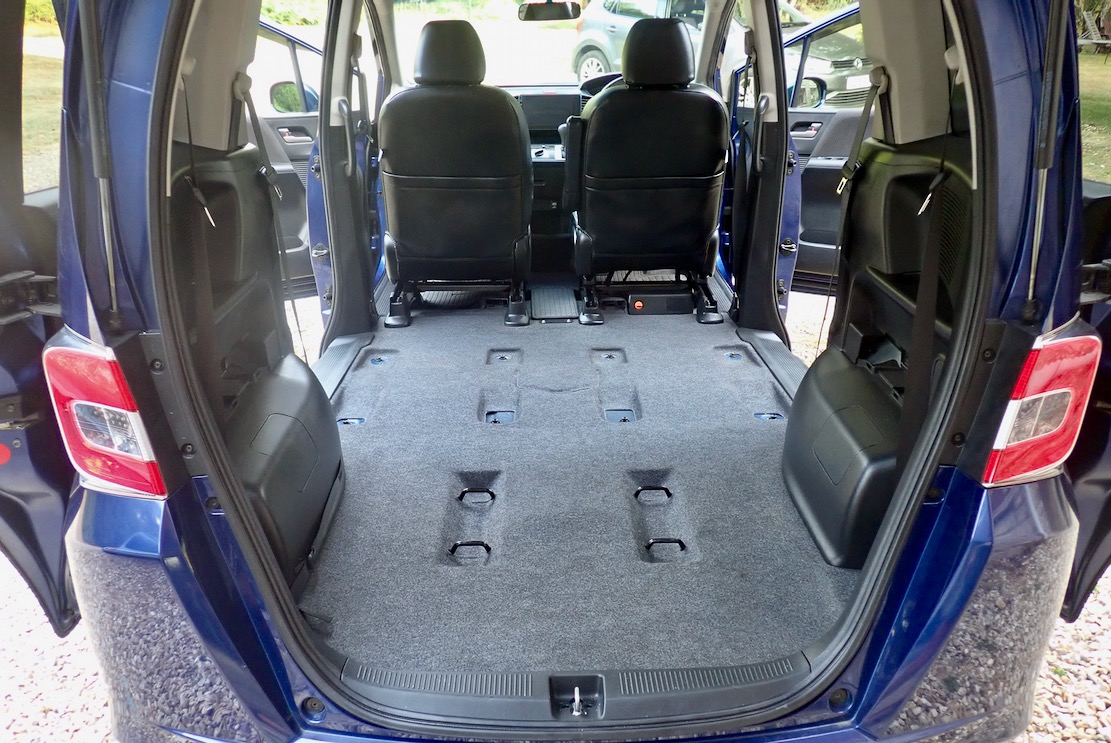

As you can see a Freed looks a tad short for two, wheels-on bikes but crucially, once 80 kilos of rear seats have been removed, the two front seats have a gap where a cubby box or gear stick usually sits, so my XL Tero front wheel can slip in and the geef’s Lapierre will roll in with a bit less huffing and puffing on a trolley wheel (below; a moto idea I’ve adapted).
Comfy rides in our new, bike transporting micro camper to far away places await.

Leave a Reply