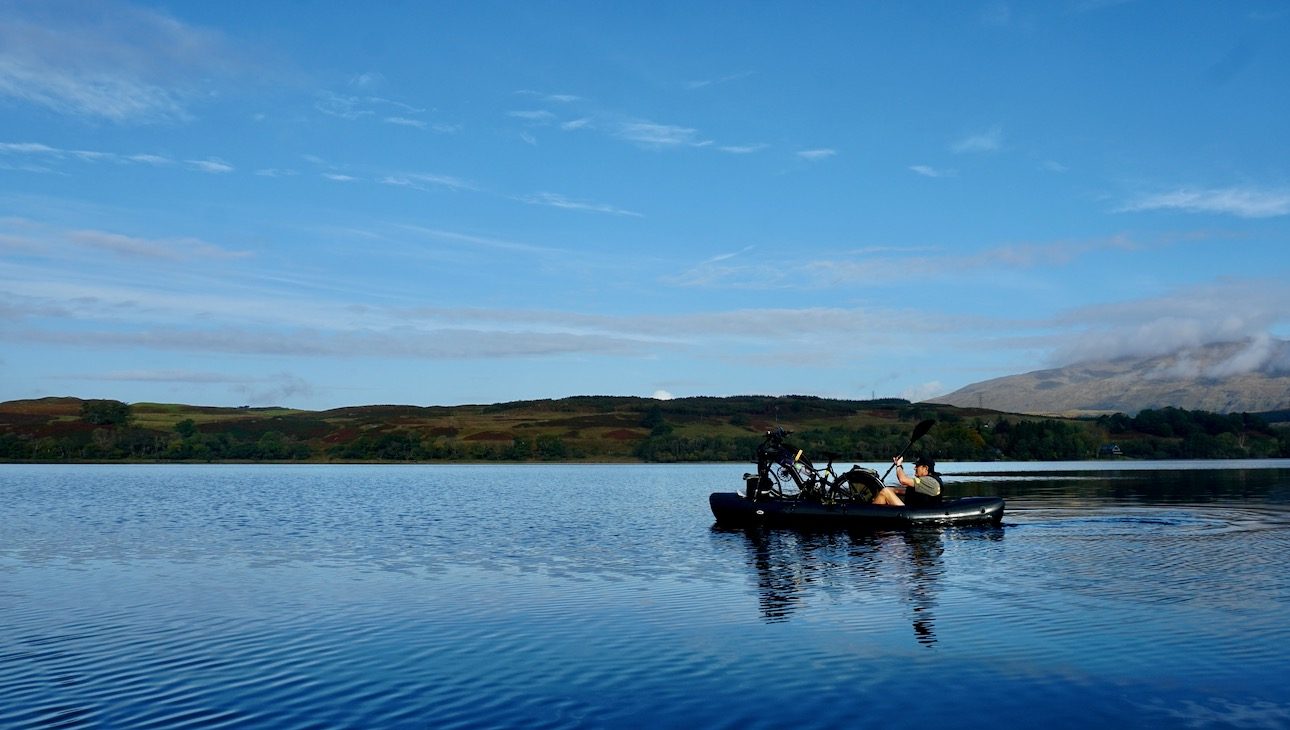

After days of rain the skies cleared to an autumnal chill so Phil (who’d invited me up here) and I planned a ride around Loch Awe. At 40-km end to end, it’s Scotland’s longest freshwater loch, just inland from Oban on the coast. To complete a full circumnavigation on roads and what few tracks there were would add up to 100km, quite a big day, some of it on the busy A85 Oban road.


Luckily we had packrafts (above) – tough and well proven mini rafts that weigh just a few kilos and are not to be confused with pooltoys. They meant we could cross the narrow loch with our bikes more or less anywhere we chose, roll the boats up and ride off. From where we were based, a crossing and a lap of the loch would cover around 60km (below) including a surprisingly meaty 900-m elevation gain.

Our cottage was on the loch’s northeast side, near the 500-m narrows at Portstronachan and opposite a remote shoreside hotel accessed by a public road. The day before I’d paddled for nearly an hour into a strong wind to locate a good landing spot just past the hotel. That done, I threw up my downwind sail and zipped back across the loch in 15 minutes (below).

Phil’s Brompton bike is powered by small drill batteries which had about 30km range at the very best. Factor in the undulating loch-side road plus the weight of the gear, actual battery range might be less than half that. With a couple of spares batteries (some better than others), he planned to re-cross the loch when the time came, while I carried on all the way round.
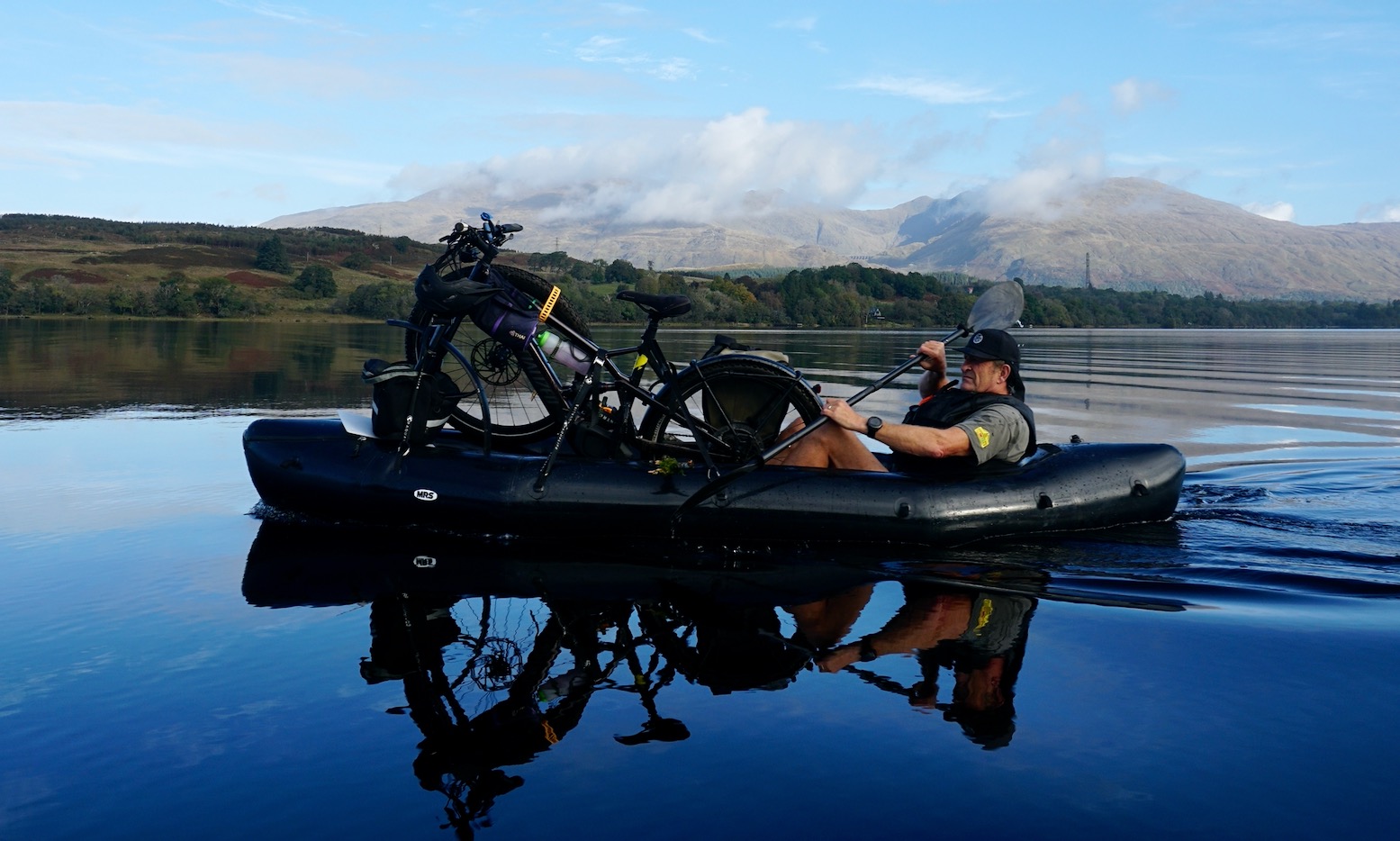
Even though the day dawned calm, I was wary of laying my 28-kilo Specialized Tero across the splash-prone bow of my Anfibio TXL packraft – the normal way to carry a bike on a packraft. Phil’s boat was a much longer MRS Barracuda R2 Pro – nearly 12 feet in old money, long enough to stand my bike upright with the electrics up out of the way. Once folded and in the bag, his ARCC-converted e-Brompton would drop in behind my boat’s seat.

Unlike my Anfibio, Phil’s MRS didn’t have the optional inflatable floor to help spread the rear wheel’s load once lashed down securely. He came up with the idea of passing a stick through the back wheel under the chainstay to carry the bike’s weight off the floor and on the fat side tubes (above). With the front wheel off and the forks sat in a bag resting on a chopping board pinched from the cottage kitchen, we set off across the glassy span of Loch Awe. Behind us, the 1126-m mass of Ben Chruachan watched as we inched across. After 15 years of packrafting, it still amazes me how easily these boats glide with big loads, then roll up into a backpack or pannier.
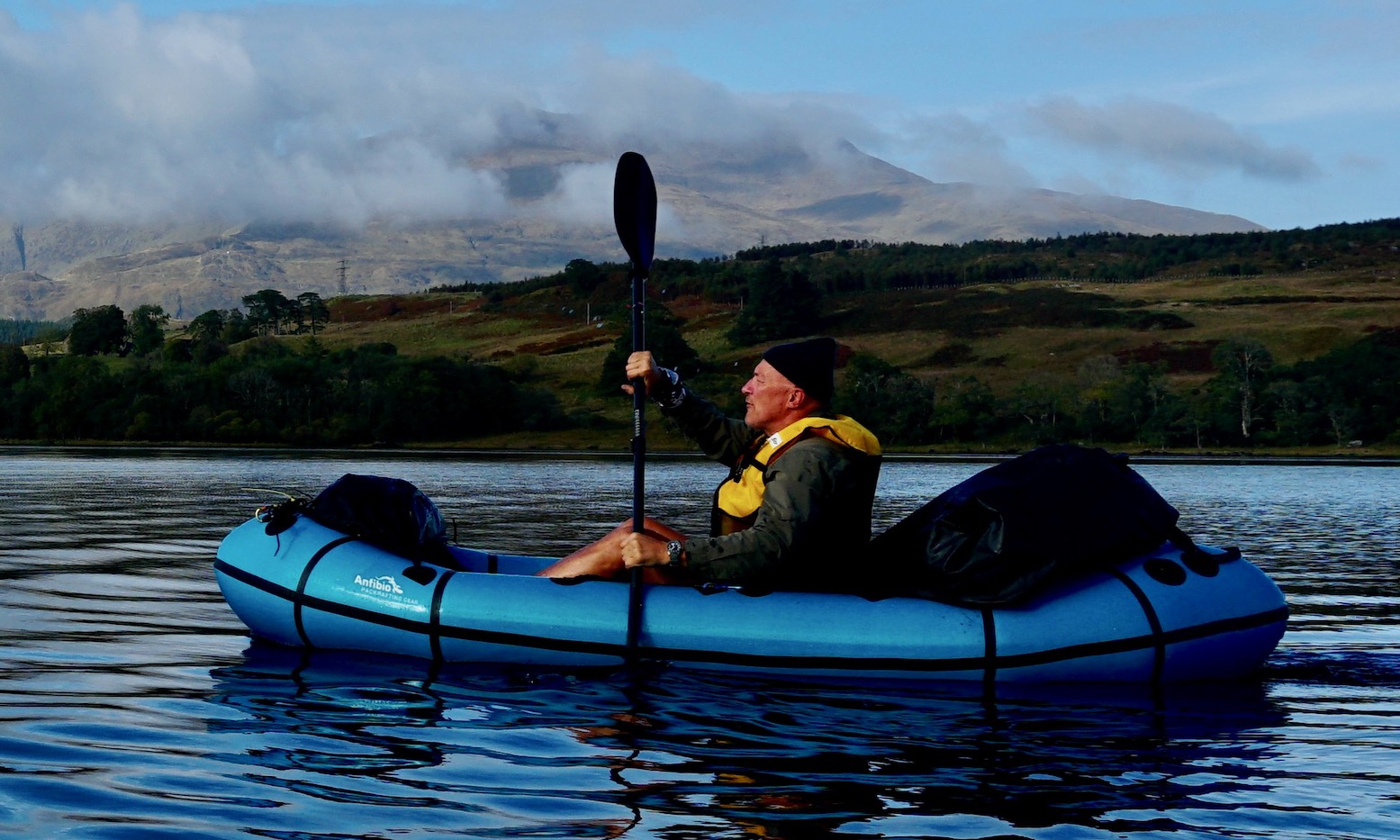

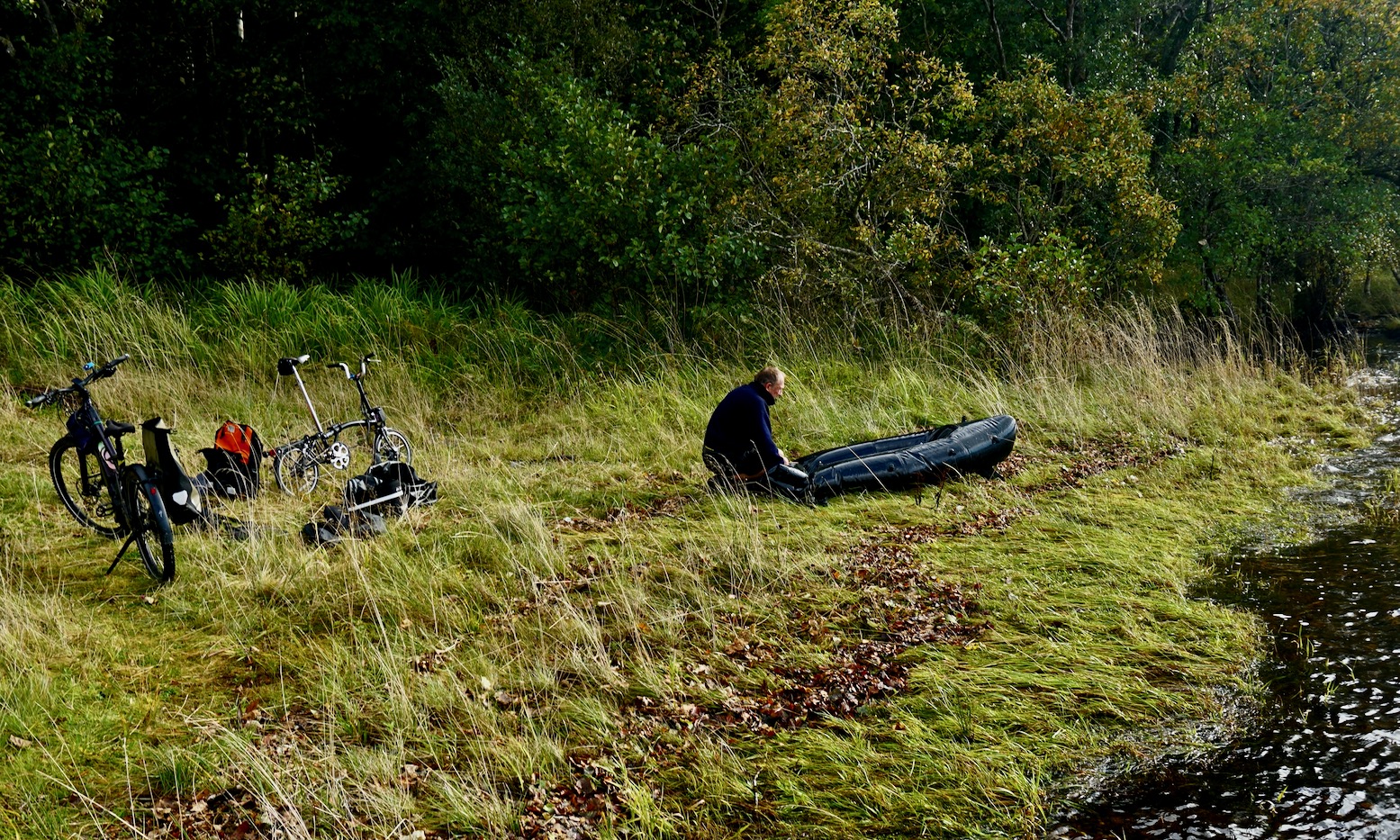
About halfway across the wind picked up, ruffling the surface of the loch. We passed the hotel and pulled into the beach by a stone jetty, deflated our rafts and assembled our bikes.


Pedalling southwest along the road, I was surprised how many houses there were. Just an hour or two from Glasgow and much less to Oban, the shores of Loch Awe had the domestic feel of a retirement colony; quite different from the wind-lashed wilds of the Coigach and Summer Isles in the far northwest were we relocated annually for many years. I was also struck how comparatively lush it was down here, the roadsides were thick with deciduous native woodland and moss, just like the similarly rain-drenched west coast of New Zealand we’d paddled and pedalled earlier in the year.

Laden down with his big raft, Phil’s Brompton wasn’t as nippy as the Tero and the rarely level road on this first section of the full loop meant he needed to swap batteries just before we arrived the welcome Wild Rowan Cafe/Shop/Post Office at Dalavich [KM14].

Out of Dalavich a stiff, 200-m climb up rose onto a clear-felled hillside which would have finished off the Brompton. So after some soup and toasties, Phil and I parted ways: he coasted down to the loch side to cut about 30km from his ride. I carried on southwest, huffing and puffing up the big hill where I thought I might get a long shot of Phil paddling far below. But the loch was out of sight and there was nothing to see here but tree stumps.
On this northwest side of the loch, the map showed an unusually dense network of forestry and windfarm tracks (below) which can be threaded together, through at least half the trees shown on the OS map have been cleared when you switch to satellite view.

The OS map also shows the Inverliever Cycle Trail (above), though I found nothing online. Had I spent more time up here, it would have been fun to explore these trails, while ideally lodged on the sunnier west side of Loch Awe. Rideable trails like this were something we missed in the far northwest where plantations were rare. That left only paths and rougher tracks which could be hard work on an MTB, even if in Scotland bikes can technically roam anywhere. Of course it remains to be seen what state the Inverliever tracks are in following days of rain. A bike rental shop in Dalavich suggests a couple of modest loops that add up to less than an hour or two’s riding.

I idly wondered if I might catch Phil up on the far side. Could I pedal 30 clicks quicker than he could deploy, paddle a kilometre and repack his raft? Even with assist up to 25kph, you can’t really push hard on a Tero loaded for amphibious activities, so I just pedalled normally and enjoyed the downhill rests.
I turned left at Ford village, a former droving stop but in terms of services, these days just a defib phone box. Now with the wind and sun behind me, I started up Loch Awe’s east side. With the flatter road running closer to the loch’s shore, it was a more scenic ride. In the meantime I’ve acquired a new word for my skimpy Gaelic lexicon: crannog, or artificial island very close to the shore dating from the late Bronze or Iron Age. There were about twenty loaded in Loch Awe as well as many Neolithic sites on the map, remnants of human occupation dating back thousands of years. Right up to a couple of hundred years ago, waterways up here offered easier travel, and islands better protection.

There are several intriguing natural islands in Loch Awe too, as we were to discover, and since it was dammed in the mid 1960s, the loch is some 3 metres higher, so the crannogs would once have been even nearer the bank. This raised level explained the many old fences we saw disappearing into the water.

I was whizzing along enjoying the views and low-level work-out and was surprised to come across Phil on the roadside, making final adjustments to his reloaded Brompton.

‘That’s amazing!’ he exclaimed, but he must have taken his time since we parted in Dalavich, as I’d averaged a pretty normal 18kph over the 30km. We pedalled on the final 14km back to the cottage and put the kettle on.

It would be good to try and mount the Tero on my TXL packraft, perhaps with a splash cover, but it’s a lot of clutter and weight, and tbh I’m not that into mixing my biking with rafting. Loch Awe had been an ideal bikeraft application: a short crossing to access a much longer ride.
A folding e-bike like Phil’s would work better. I have the makings of that in my Dahon cheapie (below). The Mu’s two-speed auto shifting hub had been an interesting experiment, but realistically suits, flat unloaded road rides – not really what I do. I’ve just bought myself a used Shimano Nexus 8-speed wheel to fit, and am still waiting for my Kamingo clip-on motor which might arrive any month now. That combination should make a practical folding e-bike.

Leave a Reply