
Although I won’t miss being thwacked in the shins by MTB pedal studs, I’m not entirely won over by my Tero X5‘s OE Specialized Commuter ‘sandboard’ pedals for my intended use. I suppose commuters prefer not chewing up their city soles, but on the trail and with mud-clogged footwear, I’m not convinced they’ll work with my current, hard-soled water shoes.

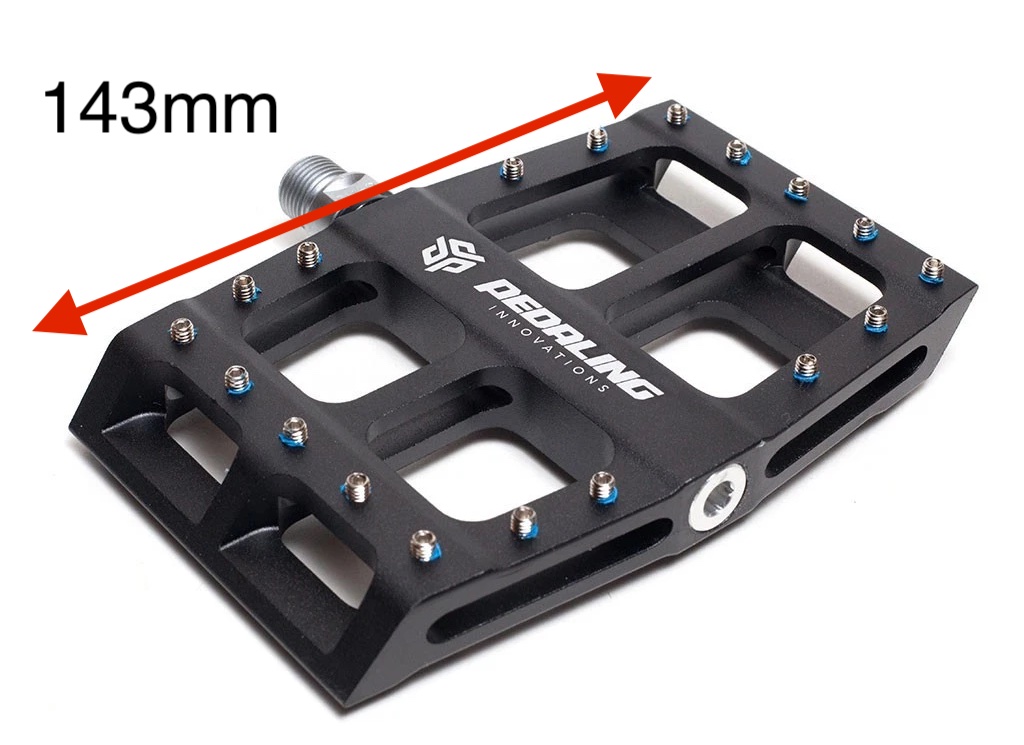
Sandpaper flats aren’t some clever pedalling innovation, but extra long Pedalling Innovations’ Catalyst One MTB pedals (below) certainly were when they came out a few years ago. It’s in the brand name, after all! Curious, I nibbled at the bait then promptly plummeted down a rabbit hole. It’s what internet is for.
The Catalyst reviews are largely positive, especially among riders with large feet like myself. The graphic below left explains Pedalling Innovations’ reasoning, and it’s reasonably convincing. But so was the rationale behind Shimano Biopace in the 1980s – my go-to Emperor’s New Clothes Alert, or ‘ENCA’ as it’s known in the trade. Catalysts have been around for years, over which time they’ve grown longer still, with the standard ones now 143mm long, and XLs at 180mm for kangaroos and those with feet even larger than mine.


Short version: with the longer platform you position your foot further forward with the arch over the pedal spindle, not the balls of your feet. But as the linked review above observes, unless you can move your saddle forward three inches, that effectively increases the distance from saddle to feet (like longer cranks), reducing pressure on the pedals when sat down, though there are said to be other benefits.

It’s also said the longer Catalyst platform reduces the need for special, stiff-soled MTB shoes like below left. One less pair of shoes to own. Win! (I bought some, anyway – Lose).


Catalyst pedals are made in Colorado so with the punishing tariffs on long-pedals, cost a hefty 208 quid by the time they reach the UK. I think my Chinesium DMRs on the Merida came in at £25. You’d think after nearly a decade, there’d be suspiciously similar designs on Ali Express and ebay. Not yet. All I could find was Crankbrothers slapping the ‘Evo’ buzzword on their recent 133mm-long Stamps (above right). “An extended platform for greater stability, less fatigue, and improved efficiency.” Sounds great! Price? £199. Oh.

Going Large
By now I’d glugged back enough Kool Aid to convince myself that, just like a large person wants a large frame, large feet benefit from larger pedals. I was all set to screw on some experimental plywood footboards to the Commuters like the bodger I am, when a set of used Catalysts in green popped up on ebay cheap.

As you’d expect, you have to break the habit of positioning your feet each time you pull away or when you need to optimise effort on a climb. On the road and easy trails I can’t say I felt any difference in power, stability, added comfort or reduced fatigue with feet forward, but I think these are MTB pedals designed for stuff rougher than I tackle these days. I’d imagine the difference might be most noticeable on rough descents like Ballard Down coming into the Swanage, road. But take it slow, stand up and place the feet centrally for less calf strain, and you’ll get down well enough with regular-sized flats.

I did about 80km on the Catalysts but was not convinced they were a major improvement to the sort of softcore pedalling I do. I spent too much time shuffling my feet into the unaccustomed position without noticing any of the revelations others speak of. Upshot: the Commuters are now on the geef’s Lapierre, and I’ve fitted some used but nicely wide Crankbrothers Stamp 7s (above left) to the Tero X5.

Leave a Reply